
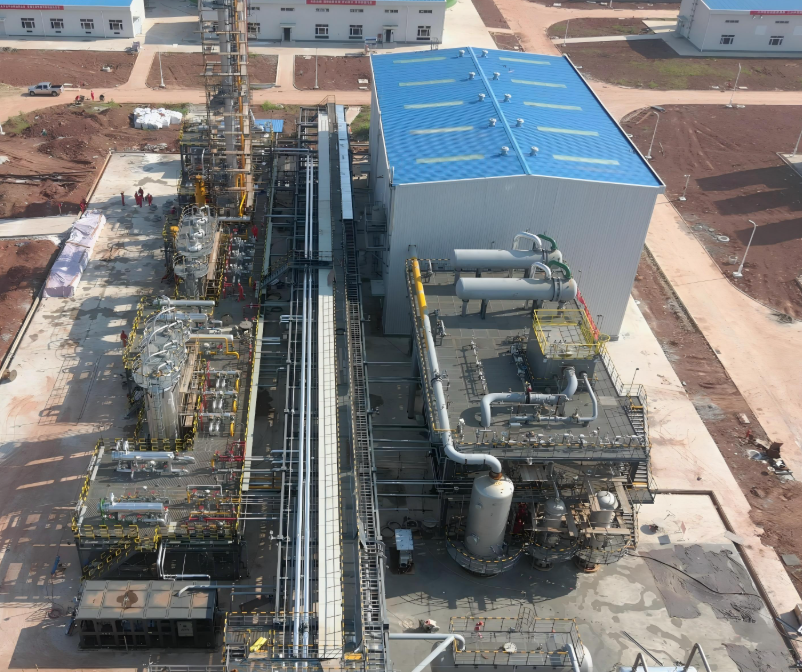
Transportation of natural gas from extraction sites to consumers is technically difficult. Gas fields are often thousands of miles away from the nearest city or factory. It is impractical to transport natural gas using large vehicles like trucks or ships due to the large amounts of space natural gas occupies. Liquefied natural gas are used to transport natural gas by bringing it's engineered volume to a substantially smaller size, facilitating the ability of natural gas to cross oceans and continents.
Transporting large amounts of energy across oceans has traditionally been technically impossible. A standard liquefied natural gas (LNG) ship is able to transport seven hundred times the amount of natural gas. This is due to the the transport technology which ironically reduces natural gas to a liquid by cooling it to minus 162 degrees Celsius. This process also reduces the volume of natural gas by 600 times. The ability to transport such a large amount of energy across oceans and continents is, ironically, due to the relatively small volume of natural gas. These ships would not have the ability to transport such a vast amount of energy across oceans and continents. liquefaction is the key to the transport of natural gas.
Expansion of Pipeline Trade to LNG
Gas pipelines are effective at carrying gas overland, but they are limited. For example, they cannot be built across oceans, or within different countries because of political and diplomatic issues, delays, and high costs. Gas pipelines also are a permanent trade route. Once gas is traded along that route it cannot be traded elsewhere. A gas pipeline is also permanent along a route. Once gas is traded, the pipeline cannot be used elsewhere.
Liquid gas carriers can do this and so can ships. You can gas up a carrier at a terminal and turn any gas pipeline issuer into a gas trade route. Other trade routes simply cannot do that. If the prices for trade to gas customers is higher in a different country than the destination country, then the recipient of the gas can be changed. Gas pipelines are also permanent in an interim (aimed at preventing costs, issues, and delays in a permanent) route.
Streamlining Long Distance Natural Gas Transportation
Cost of transportation using liquid natural gas and pipelines relies heavily on distance. For shorter distances, a pipeline is more cost effective. However, for distances beyond a certain point, liquid natural gas may be a cost effective option as well. Studies show that this cost efficient distance is around 1,700 mile. Beyond this distance, liquid natural gas is less expensive to ship. This difference is pronounced for overseas routes. Studies indicate that it is 40 percent less to ship gas via sea transport than it is to ship via pipeline. For these overseas routes, especially to areas like the Middle East, liquid natural gas is the most cost effective option.
The Three Step Journey from Well to Customer
Transporting liquefied natural gas is an involved process. Three activities make up this process. First, the process is liquefaction. The natural gas is first processed and cleaned up of contaminants like water and dioxide. After being cleaned, the natural gas is chilled to the point of being liquified. This process occurs at terminals, which are usually sited at gas fields or ports. The second activity in the process is shipping. The liquified natural gas is transported in unlike cargo ships, called LNG carriers. These ships are specially designed to have double hulls, and insulated tanks to handle the shipping. Even during the trip, some of the liquified gas transitions back to a gaseous state. The ship is designed to capture this transitioning gas and use it to fuel the ship, and the ishandler sustain the ship for further shipping. The final act in this three activity process is regasification. This act occurs after the ship and its cargo reach the final destination. The liquified natural gas is refueled, and then returned back to its gaseous state. The natural gas is then introduced to the local pipeline systems to supply adjoining homes and businesses.
The process of regasification essentially signifies the completion of the cycle. The process sounds technical, but the core concept isn't that complicated. At the final recipient’s terminal, the liquefied natural gas is stored in large insulated containers. Whenever gas is required, the liquid is routed to a heat exchanger. To turn the liquid back into gas, either the warm ambient air or warm seawater is used. Once the natural gas is in the gaseous state, it is ready to be distributed through the pipelines. Some terminals even make use of the cold energy that is released during the process to further support other needs, such as the building’s cooling system or to cool a process. This is a fiscal advantage in addition to the function served.
Delivering Natural Gas to Gas Desperate Regions
The most distinguishing feature of liquefied natural gas is its ability to bring energy to the farthest and most neglected regions of the world. Many countries and even entire islands lack pipeline connectivity, and some regions will never acquire them. For example, laying an underwater gas pipeline across hundreds of miles of open waters is practically unrealistic. While these places are cut off from natural gas, they can construct small import terminals to allow for the reception of natural gas LNG deliveries. This capability has opened energy frontier access for multiple countries. Liquefied natural gas is added to gas supply chain security. In case of the loss of an energy supply contract on gas from one of the sources, a country can seamlessly turn to the liquefied natural gas market and gas supply from the different contracted venders. This is what Europe did. After Russia precluded its gas pipeline to Europe and the latter began to receive liquefied natural gas from the USA and Qatar.
An Expanding Interconnected Global Trade System
The figures show the steady fusion of the world's LNG trade. In 2025 it is estimated that 22 exporting countries will send 48 countries a total of 429 million tons of LNG. The USA will outpace all other exporters for the first time. In the importing countries, Japan is overtaken by China, with Europe rapidly becoming an importer too. The trade routes of liquid gas coupled with the liquefaction plants and the regasification terminals is a new kind of global trade system. In the advanced system gas can be harvested, exported, liquefied, and delivered to a receiver in a different continent in less than a month. Such trade has not been achieved in the hundreds of years of international trade.